

How To Draw Phase Bode Plot
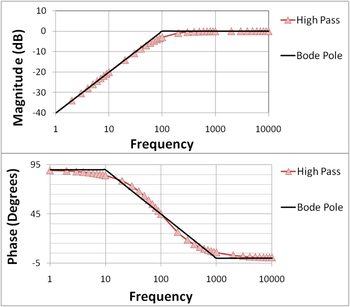
Effigy 1A: The Bode plot for a first-order (1-pole) highpass filter; the directly-line approximations are labeled "Bode pole"; phase varies from 90° at low frequencies (due to the contribution of the numerator, which is 90° at all frequencies) to 0° at loftier frequencies (where the stage contribution of the denominator is −ninety° and cancels the contribution of the numerator).

Effigy 1B: The Bode plot for a first-order (one-pole) lowpass filter; the straight-line approximations are labeled "Bode pole"; phase is xc° lower than for Figure 1A because the phase contribution of the numerator is 0° at all frequencies.
In electrical engineering and command theory, a Bode plot is a graph of the frequency response of a system. It is usually a combination of a Bode magnitude plot, expressing the magnitude (usually in decibels) of the frequency response, and a Bode phase plot, expressing the phase shift.
Equally originally conceived past Hendrik Wade Bode in the 1930s, the plot is an asymptotic approximation of the frequency response, using straight line segments.[ane]
Overview [edit]
Amongst his several of import contributions to excursion theory and command theory, engineer Hendrik Wade Bode, while working at Bell Labs in the 1930s, devised a simple merely authentic method for graphing gain and phase-shift plots. These conduct his name, Bode gain plot and Bode phase plot. "Bode" is often pronounced BOH-dee although the Dutch pronunciation is Bo-duh. (Dutch: [ˈboːdə]).[2] [iii]
Bode was faced with the problem of designing stable amplifiers with feedback for use in telephone networks. He developed the graphical design technique of the Bode plots to prove the proceeds margin and phase margin required to maintain stability under variations in circuit characteristics caused during manufacture or during performance.[iv] The principles developed were applied to design issues of servomechanisms and other feedback control systems. The Bode plot is an example of analysis in the frequency domain.
Definition [edit]
The Bode plot for a linear, time-invariant system with transfer function ( beingness the complex frequency in the Laplace domain) consists of a magnitude plot and a phase plot.


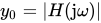
The Bode magnitude plot is the graph of the office of frequency (with being the imaginary unit). The -axis of the magnitude plot is logarithmic and the magnitude is given in decibels, i.e., a value for the magnitude is plotted on the axis at .


The Bode phase plot is the graph of the phase, commonly expressed in degrees, of the transfer function equally a function of . The phase is plotted on the aforementioned logarithmic -axis as the magnitude plot, but the value for the phase is plotted on a linear vertical axis.

Frequency response [edit]
This section illustrates that a Bode Plot is a visualization of the frequency response of a system.
Consider a linear, time-invariant system with transfer role . Assume that the system is subject to a sinusoidal input with frequency ,

that is applied persistently, i.due east. from a fourth dimension to a fourth dimension . The response will be of the form



i.e., also a sinusoidal bespeak with amplitude shifted in phase with respect to the input past a phase .


It can be shown[5] that the magnitude of the response is
-
(1)
and that the phase shift is
-
(2)

A sketch for the proof of these equations is given in the appendix.
In summary, subjected to an input with frequency the organisation responds at the same frequency with an output that is amplified by a gene and phase-shifted past . These quantities, thus, characterize the frequency response and are shown in the Bode plot.


Rules for handmade Bode plot [edit]
For many applied problems, the detailed Bode plots tin be approximated with direct-line segments that are asymptotes of the precise response. The effect of each of the terms of a multiple element transfer role can be approximated by a set of straight lines on a Bode plot. This allows a graphical solution of the overall frequency response function. Before widespread availability of digital computers, graphical methods were extensively used to reduce the demand for tedious adding; a graphical solution could be used to identify feasible ranges of parameters for a new design.
The premise of a Bode plot is that one tin can consider the log of a function in the form:

every bit a sum of the logs of its zeros and poles:

This idea is used explicitly in the method for cartoon phase diagrams. The method for drawing amplitude plots implicitly uses this idea, but since the log of the amplitude of each pole or zero always starts at zero and only has 1 asymptote alter (the direct lines), the method tin be simplified.
Directly-line amplitude plot [edit]
Amplitude decibels is usually washed using to define decibels. Given a transfer function in the form

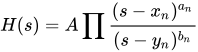
where and are constants, , , and is the transfer function:


To handle irreducible 2nd order polynomials, can, in many cases, be approximated as .

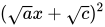
Note that zeros and poles happen when is equal to a certain or . This is considering the role in question is the magnitude of , and since information technology is a complex office, . Thus at any place where at that place is a null or pole involving the term , the magnitude of that term is .




Corrected amplitude plot [edit]
To right a straight-line aamplitude plot:
Note that this correction method does non incorporate how to handle complex values of or . In the instance of an irreducible polynomial, the best way to right the plot is to actually calculate the magnitude of the transfer function at the pole or zero corresponding to the irreducible polynomial, and put that dot over or under the line at that pole or zero.
Straight-line stage plot [edit]
Given a transfer function in the same grade as above:
the idea is to draw separate plots for each pole and zero, and then add together them up. The actual phase curve is given by .
![-\arctan \left({\tfrac {{\mathrm {Im}}[H(s)]}{{\mathrm {Re}}[H(s)]}}\right)](https://wikimedia.org/api/rest_v1/media/math/render/svg/67541821bb17adfa48f97d0c120d30b71d9199a8)
To draw the stage plot, for each pole and zippo:
- If is positive, beginning line (with zero slope) at
- If is negative, commencement line (with aught slope) at
- If the sum of the number of unstable zeros and poles is odd, add 180° to that basis
- At every (for stable zeros
), increment the slope past degrees per decade, beginning one decade earlier (E.g.: )
- At every (for stable poles
), subtract the gradient by degrees per decade, kickoff one decade before (Eastward.g.: )
- "Unstable" (correct half plane) poles and zeros ( ) take opposite beliefs
- Flatten the slope again when the phase has changed by degrees (for a cipher) or degrees (for a pole),
- After plotting one line for each pole or zero, add together the lines together to obtain the final phase plot; that is, the final phase plot is the superposition of each earlier phase plot.


Case [edit]
To create a straight-line plot for a first-order (i-pole) lowpass filter, one considers the transfer function in terms of the angular frequency:
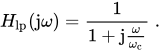
The to a higher place equation is the normalized grade of the transfer function. The Bode plot is shown in Figure ane(b) above, and construction of the straight-line approximation is discussed next.
Magnitude plot [edit]
The magnitude (in decibels) of the transfer function above, (normalized and converted to athwart frequency form), given by the decibel gain expression :

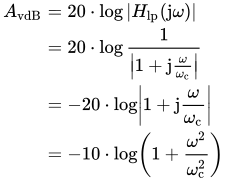
Then plotted versus input frequency on a logarithmic calibration, tin be approximated past two lines and it forms the asymptotic (approximate) magnitude Bode plot of the transfer function:
These ii lines see at the corner frequency. From the plot, information technology can be seen that for frequencies well beneath the corner frequency, the excursion has an attenuation of 0 dB, corresponding to a unity pass ring gain, i.e. the aamplitude of the filter output equals the amplitude of the input. Frequencies above the corner frequency are attenuated – the higher the frequency, the higher the attenuation.
Phase plot [edit]
The stage Bode plot is obtained past plotting the phase bending of the transfer function given by

versus , where and are the input and cutoff angular frequencies respectively. For input frequencies much lower than corner, the ratio is small and therefore the phase bending is close to zero. Every bit the ratio increases the accented value of the phase increases and becomes −45 degrees when . As the ratio increases for input frequencies much greater than the corner frequency, the phase angle asymptotically approaches −90 degrees. The frequency scale for the phase plot is logarithmic.


Normalized plot [edit]
The horizontal frequency axis, in both the magnitude and phase plots, tin be replaced past the normalized (nondimensional) frequency ratio . In such a case the plot is said to be normalized and units of the frequencies are no longer used since all input frequencies are now expressed as multiples of the cutoff frequency .
An case with zip and pole [edit]
Figures two-five further illustrate structure of Bode plots. This example with both a pole and a zero shows how to use superposition. To begin, the components are presented separately.
Figure two shows the Bode magnitude plot for a cipher and a low-pass pole, and compares the 2 with the Bode straight line plots. The straight-line plots are horizontal up to the pole (null) location and then drop (rise) at xx dB/decade. The second Figure 3 does the aforementioned for the stage. The stage plots are horizontal up to a frequency cistron of 10 beneath the pole (zero) location so drop (rising) at 45°/decade until the frequency is x times higher than the pole (zero) location. The plots so are again horizontal at higher frequencies at a final, total stage change of 90°.
Figure 4 and Figure 5 show how superposition (simple addition) of a pole and goose egg plot is washed. The Bode straight line plots again are compared with the exact plots. The nil has been moved to college frequency than the pole to make a more interesting example. Notice in Figure 4 that the 20 dB/decade drop of the pole is arrested past the 20 dB/decade ascent of the zero resulting in a horizontal magnitude plot for frequencies higher up the zero location. Find in Figure five in the phase plot that the straight-line approximation is pretty approximate in the region where both pole and nix affect the phase. Find also in Figure v that the range of frequencies where the stage changes in the directly line plot is express to frequencies a gene of x above and beneath the pole (zero) location. Where the phase of the pole and the zero both are present, the straight-line phase plot is horizontal because the 45°/decade drib of the pole is arrested by the overlapping 45°/decade rise of the nix in the limited range of frequencies where both are active contributors to the phase.
- Example with pole and cypher
-
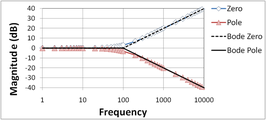
Effigy 2: Bode magnitude plot for zippo and low-pass pole; curves labeled "Bode" are the straight-line Bode plots
-

Figure 3: Bode phase plot for nix and depression-pass pole; curves labeled "Bode" are the straight-line Bode plots
-

Figure 4: Bode magnitude plot for pole-zero combination; the location of the zero is 10 times college than in Figures 2 and 3; curves labeled "Bode" are the straight-line Bode plots
-
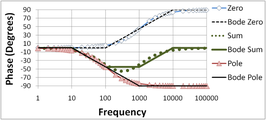
Figure 5: Bode phase plot for pole-nil combination; the location of the aught is x times higher than in Figures 2 and 3; curves labeled "Bode" are the direct-line Bode plots
Gain margin and phase margin [edit]
Bode plots are used to appraise the stability of negative feedback amplifiers by finding the gain and phase margins of an amplifier. The notion of proceeds and phase margin is based upon the gain expression for a negative feedback amplifier given past

where AFB is the gain of the amplifier with feedback (the closed-loop proceeds), β is the feedback factor and A OL is the gain without feedback (the open-loop gain). The proceeds A OL is a circuitous function of frequency, with both magnitude and phase.[note ane] Examination of this relation shows the possibility of infinite gain (interpreted as instability) if the product βA OL = −1. (That is, the magnitude of βA OL is unity and its phase is −180°, the then-called Barkhausen stability benchmark). Bode plots are used to determine just how close an amplifier comes to satisfying this condition.
Cardinal to this conclusion are two frequencies. The kickoff, labeled here equally f 180, is the frequency where the open up-loop gain flips sign. The 2d, labeled here f 0 dB, is the frequency where the magnitude of the product | β A OL | = 1 (in dB, magnitude ane is 0 dB). That is, frequency f 180 is determined by the condition:

where vertical confined denote the magnitude of a complex number (for example, ), and frequency f 0 dB is determined by the condition:
![|a+{\mathrm {j}}b|=\left[a^{2}+b^{2}\right]^{{{\frac 12}}}](https://wikimedia.org/api/rest_v1/media/math/render/svg/8f9fca916ec587a099995e0427966806c8b4d2e2)

One measure of proximity to instability is the proceeds margin. The Bode stage plot locates the frequency where the phase of βA OL reaches −180°, denoted here as frequency f 180. Using this frequency, the Bode magnitude plot finds the magnitude of βA OL. If |βA OL|180 ≥ 1, the amplifier is unstable, as mentioned. If |βA OL|180 < 1, instability does not occur, and the separation in dB of the magnitude of |βA OL|180 from |βA OL| = 1 is chosen the gain margin. Because a magnitude of one is 0 dB, the gain margin is simply i of the equivalent forms: .

Another equivalent measure of proximity to instability is the phase margin. The Bode magnitude plot locates the frequency where the magnitude of |βA OL| reaches unity, denoted here as frequency f 0 dB. Using this frequency, the Bode stage plot finds the phase of βA OL. If the stage of βA OL( f 0 dB) > −180°, the instability status cannot be met at whatever frequency (because its magnitude is going to be < one when f = f 180), and the altitude of the phase at f 0 dB in degrees above −180° is called the phase margin.
If a simple aye or no on the stability event is all that is needed, the amplifier is stable if f 0 dB < f 180. This criterion is sufficient to predict stability only for amplifiers satisfying some restrictions on their pole and null positions (minimum phase systems). Although these restrictions normally are met, if they are not another method must be used, such equally the Nyquist plot.[six] [7] Optimal gain and phase margins may be computed using Nevanlinna–Pick interpolation theory.[eight]
Examples using Bode plots [edit]
Figures 6 and 7 illustrate the gain beliefs and terminology. For a 3-pole amplifier, Effigy 6 compares the Bode plot for the gain without feedback (the open up-loop gain) A OL with the gain with feedback A FB (the airtight-loop gain). Encounter negative feedback amplifier for more particular.
In this example, A OL = 100 dB at low frequencies, and 1 / β = 58 dB. At low frequencies, A FB ≈ 58 dB too.
Because the open-loop gain A OL is plotted and not the product β A OL, the condition A OL = 1 / β decides f 0 dB. The feedback proceeds at depression frequencies and for big A OL is A FB ≈ i / β (look at the formula for the feedback gain at the beginning of this section for the case of big gain A OL), so an equivalent way to detect f 0 dB is to await where the feedback gain intersects the open up-loop gain. (Frequency f 0 dB is needed later to find the phase margin.)
Near this crossover of the two gains at f 0 dB, the Barkhausen criteria are almost satisfied in this example, and the feedback amplifier exhibits a massive acme in proceeds (information technology would be infinity if β A OL = −1). Beyond the unity gain frequency f 0 dB, the open-loop gain is sufficiently small that A FB ≈ A OL (examine the formula at the beginning of this section for the example of small-scale A OL).
Figure seven shows the corresponding stage comparison: the phase of the feedback amplifier is nearly aught out to the frequency f 180 where the open-loop gain has a phase of −180°. In this vicinity, the stage of the feedback amplifier plunges abruptly downward to get almost the aforementioned as the phase of the open-loop amplifier. (Recollect, A FB ≈ A OL for pocket-size A OL.)
Comparison the labeled points in Figure 6 and Figure 7, it is seen that the unity gain frequency f 0 dB and the phase-flip frequency f 180 are very nearly equal in this amplifier, f 180 ≈ f 0 dB ≈ 3.332 kHz, which means the gain margin and phase margin are nearly zero. The amplifier is borderline stable.
Figures 8 and 9 illustrate the gain margin and phase margin for a different corporeality of feedback β. The feedback factor is chosen smaller than in Figure six or 7, moving the status | β A OL | = 1 to lower frequency. In this example, 1 / β = 77 dB, and at depression frequencies A FB ≈ 77 dB besides.
Figure eight shows the gain plot. From Figure 8, the intersection of one / β and A OL occurs at f 0 dB = 1 kHz. Find that the acme in the proceeds A FB near f 0 dB is virtually gone.[note 2] [9]
Figure 9 is the phase plot. Using the value of f 0 dB = 1 kHz institute above from the magnitude plot of Effigy viii, the open-loop phase at f 0 dB is −135°, which is a phase margin of 45° above −180°.
Using Effigy nine, for a phase of −180° the value of f 180 = 3.332 kHz (the same effect as constitute earlier, of course[note 3]). The open-loop proceeds from Figure 8 at f 180 is 58 dB, and ane / β = 77 dB, so the gain margin is xix dB.
Stability is non the sole benchmark for amplifier response, and in many applications a more stringent demand than stability is good step response. As a dominion of thumb, adept step response requires a stage margin of at least 45°, and often a margin of over lxx° is advocated, especially where component variation due to manufacturing tolerances is an consequence.[9] Run across also the discussion of phase margin in the step response article.
- Examples
-

Figure 6: Gain of feedback amplifier A FB in dB and corresponding open-loop amplifier A OL. Parameter one/β = 58 dB, and at depression frequencies A FB ≈ 58 dB also. The gain margin in this amplifier is well-nigh nix considering | βA OL| = 1 occurs at about f = f 180°.
-

Effigy 7: Phase of feedback amplifier °A FB in degrees and corresponding open-loop amplifier °A OL. The phase margin in this amplifier is nearly zero because the phase-flip occurs at virtually the unity gain frequency f = f 0 dB where | βA OL| = 1.
-
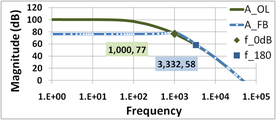
Figure 8: Gain of feedback amplifier A FB in dB and respective open-loop amplifier A OL. In this example, ane / β = 77 dB. The gain margin in this amplifier is xix dB.
-
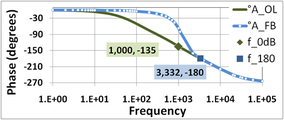
Figure nine: Phase of feedback amplifier A FB in degrees and corresponding open-loop amplifier A OL. The phase margin in this amplifier is 45°.
Bode plotter [edit]

Effigy 10: Aamplitude diagram of a 10th guild electronic filter plotted using a Bode Plotter application.
The Bode plotter is an electronic instrument resembling an oscilloscope, which produces a Bode diagram, or a graph, of a circuit's voltage proceeds or phase shift plotted confronting frequency in a feedback control organisation or a filter. An example of this is shown in Figure ten. It is extremely useful for analyzing and testing filters and the stability of feedback control systems, through the measurement of corner (cutoff) frequencies and gain and phase margins.
This is identical to the function performed by a vector network analyzer, but the network analyzer is typically used at much higher frequencies.
For educational activity/research purposes, plotting Bode diagrams for given transfer functions facilitates meliorate understanding and getting faster results (meet external links).
[edit]
Two related plots that display the same data in different coordinate systems are the Nyquist plot and the Nichols plot. These are parametric plots, with frequency as the input and magnitude and stage of the frequency response as the output. The Nyquist plot displays these in polar coordinates, with magnitude mapping to radius and phase to argument (bending). The Nichols plot displays these in rectangular coordinates, on the log scale.
-
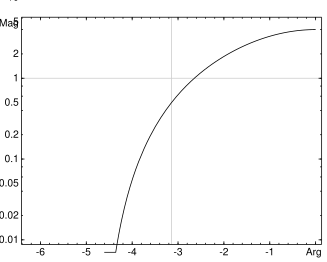
Figure 12: A Nichols plot of the same response from Figure 11.
See likewise [edit]
- Analog indicate processing
- Phase margin
- Bode'southward sensitivity integral
- Bode's magnitude (gain)–phase relation
- Electrochemical impedance spectroscopy
Notes [edit]
- ^ Unremarkably, as frequency increases the magnitude of the gain drops and the stage becomes more negative, although these are but trends and may be reversed in particular frequency ranges. Unusual gain beliefs can render the concepts of gain and phase margin inapplicable. Then other methods such every bit the Nyquist plot have to be used to assess stability.
- ^ The critical amount of feedback where the elevation in the proceeds but disappears altogether is the maximally flat or Butterworth design.
- ^ The frequency where the open-loop proceeds flips sign f 180 does not alter with a change in feedback factor; it is a property of the open-loop gain. The value of the proceeds at f 180 also does non change with a alter in β. Therefore, we could use the previous values from Figures 6 and 7. Yet, for clarity the process is described using only Figures eight and nine.
References [edit]
- ^ R. Thou. Rao Yarlagadda (2010). Analog and Digital Signals and Systems . Springer Science & Business organisation Media. p. 243. ISBN978-1-4419-0034-0.
- ^ Van Valkenburg, One thousand. E. University of Illinois at Urbana-Champaign, "In memoriam: Hendrik W. Bode (1905-1982)", IEEE Transactions on Automatic Control, Vol. Ac-29, No 3., March 1984, pp. 193-194. Quote: "Something should be said about his name. To his colleagues at Bell Laboratories and the generations of engineers that have followed, the pronunciation is boh-dee. The Bode family preferred that the original Dutch be used as boh-dah."
- ^ "Vertaling van postbode, NL>EN". mijnwoordenboek.nl. Retrieved 2013-ten-07 .
- ^ David A. Mindell Between Human and Auto: Feedback, Control, and Computing Before Cybernetics JHU Printing, 2004 ISBN 0801880572, pp. 127-131
- ^ Skogestad, Sigurd; Postlewaite, Ian (2005). Multivariable Feedback Control. Chichester, West Sussex, England: John Wiley & Sons, Ltd. ISBN0-470-01167-10.
- ^ Thomas H. Lee (2004). The design of CMOS radio-frequency integrated circuits (Second ed.). Cambridge UK: Cambridge University Printing. p. §14.6 pp. 451–453. ISBN0-521-83539-9.
- ^ William S Levine (1996). The control handbook: the electrical engineering handbook serial (2nd ed.). Boca Raton FL: CRC Press/IEEE Press. p. §ten.1 p. 163. ISBN0-8493-8570-nine.
- ^ Allen Tannenbaum (February 1981). Invariance and Systems Theory: Algebraic and Geometric Aspects. New York, NY: Springer-Verlag. ISBN9783540105657.
- ^ a b Willy M C Sansen (2006). Analog design essentials. Dordrecht, The Netherlands: Springer. pp. 157–163. ISBN0-387-25746-2.
External links [edit]
 | Wikimedia Eatables has media related to Bode plots. |
- How to describe piecewise asymptotic Bode plots
- Gnuplot code for generating Bode plot: DIN-A4 printing template (pdf)

Source: https://en.wikipedia.org/wiki/Bode_plot
Posted by: wojciechowskiadint1981.blogspot.com
0 Response to "How To Draw Phase Bode Plot"
Post a Comment