

How To Draw A Mountain Range On A Map
Cartoon Mountains Can Be a Meridian Experience With These Simple Tricks
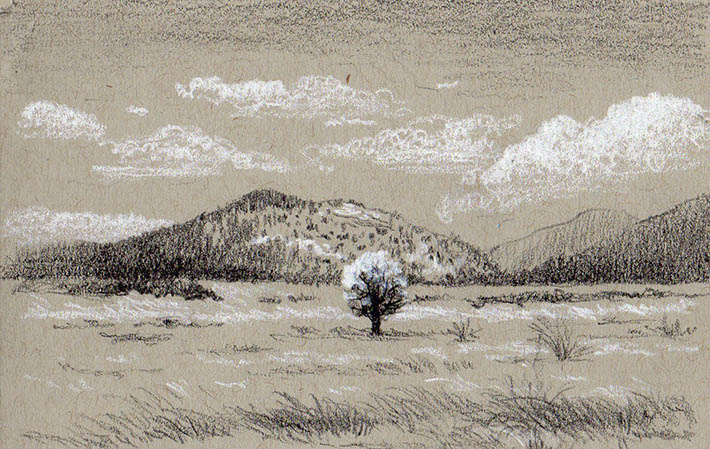
Artists take taken inspiration from mountains since … forever. Whether up close or far abroad, covered in snow or in trees, rounded or jagged, they tend to symbolize something vast and vital. And when y'all draw them, y'all want that feeling to come to life on the page. Hither's how.
Practiced to Know: These tips works no matter what medium you're using — graphite, pen and ink, colored pencil or painting.
one. Make up one's mind the Horizon Line
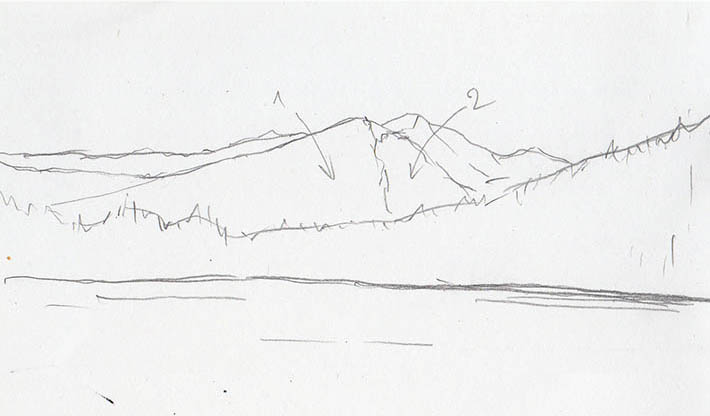
First, figure out where you want the horizon line to be on your folio and draw the outline of a mountain range to a higher place it. Unremarkably a mount range has a layered appearance, with peaks overlapping each other. The more distant the mountains, the simpler and lighter they look.
2. Divide Each Summit into Ii Major Plains
Dissever your mountains into 2 plains to create volume: calorie-free and nighttime. Shade the darkest areas showtime, building contrast between the foreground and background to make the film more eye-communicable.
Photographs can be corking reference tools, or you lot can work en plein air if you live in a mountainous area. If you're working from photos (or taking your own to reference afterwards), use images that convey a lot of data, showing the depth of field as well every bit the ideal lighting conditions.
3. Determine Altitude and Textures
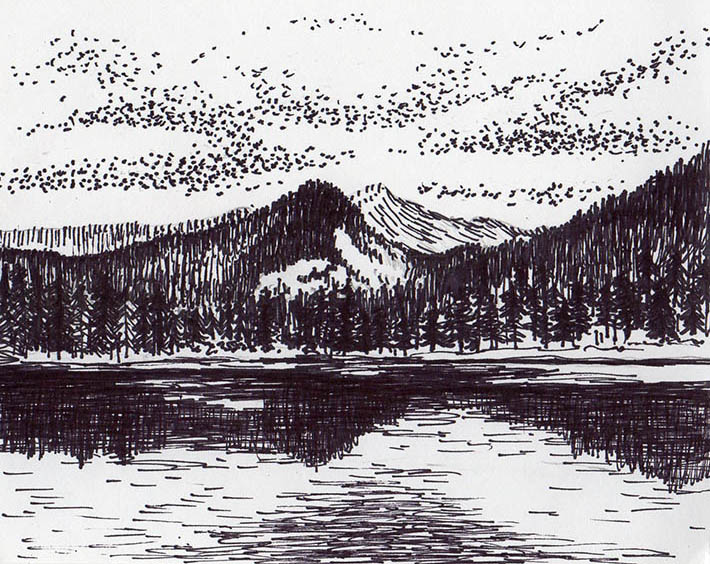
In the drawing above, the mountains are sketched with an ultra-fine black felt-tip marking. Notice that every expanse has a unique stroke direction. For far-away mountains, utilize parallel strokes to suggest distant trees and stone surfaces. To depict up-close mountains, try profile and scribble lines or crosshatching to give the impression of greater detail.
The aforementioned approach applies to your use of values. The upwards-close mountains should be darker, brighter and more than vividly detailed than those in the distance. Accept the drawing above: the nearest mountains sit low and have a flake of vegetation, while the mountains in the distance have no detail and are lighter in value.
4. Sketch in Graphite
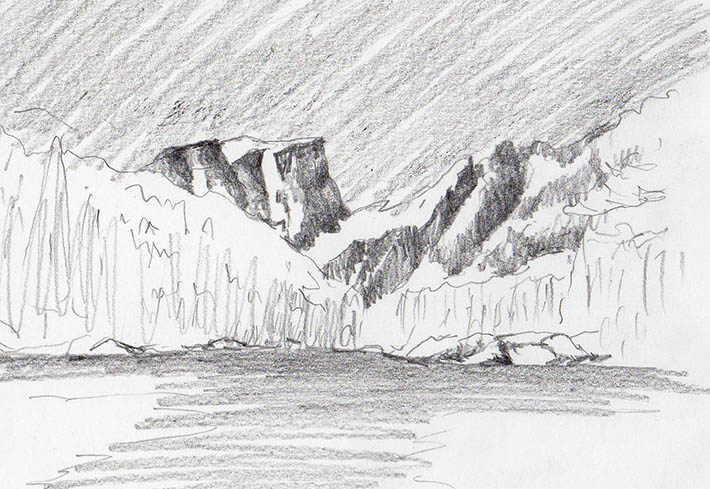
Subsequently placing the biggest elements and differentiating between light and dark areas, utilise broad pencil strokes to mark the general position of the darkest values and fill in the sky (and water, if your mural has whatsoever). It's all-time to do this in graphite, so you lot tin hands erase equally needed.
5. Add the Details
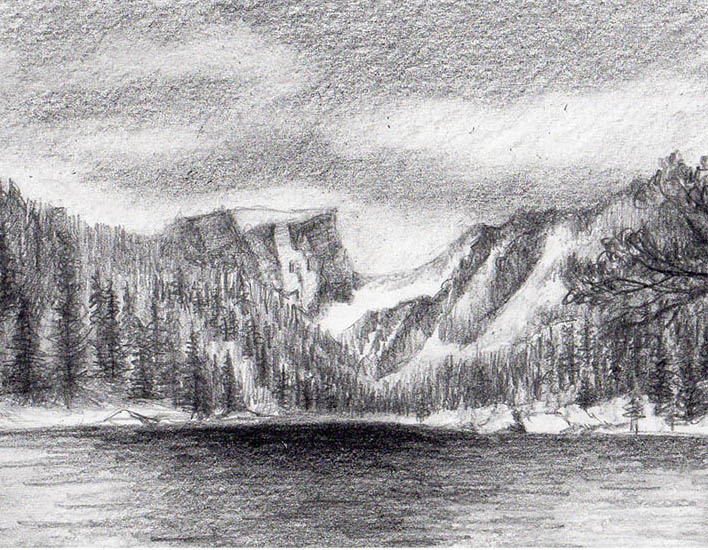
Finally, add together any extra elements — trees, snow, reflections in the h2o. Go along the sky soft to contrast the copse and sharper angles of the mountains.
<!–
Draw Better Landscapes With Elementary Techniques

Capture the beauty of whatsoever natural scene you choose! Learn foundational techniques for cartoon landscapes with lifelike dimension, texture and detail.

Source: https://www.craftsy.com/post/how-to-draw-mountains/
Posted by: wojciechowskiadint1981.blogspot.com
0 Response to "How To Draw A Mountain Range On A Map"
Post a Comment